Researchers at Keio University developed a simple chemical method that modifies proteins at their natural starting point, making it easier to design next-generation antibody medicines while expanding access to protein customization for drug discovery and research.
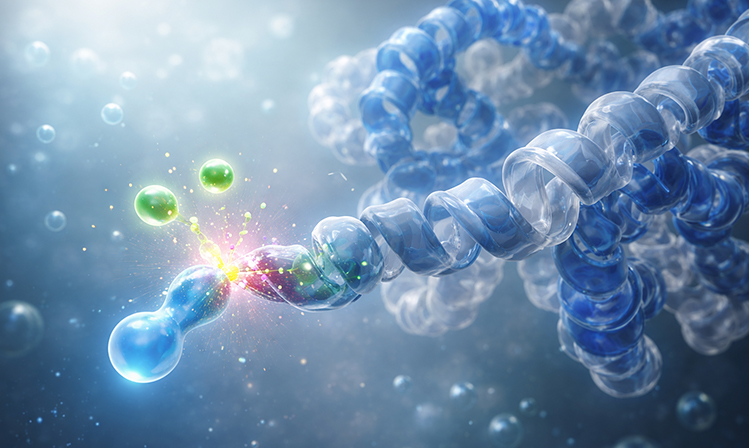
Conceptalization of a reaction modifying a protein at the N-Terminus. The image was generated using OpenAI's ChatGPT.
Why modifying proteins is difficult
Proteins are the working molecules of life, and many modern medicines―including antibody drugs used in cancer treatment―are made from them. To improve their performance, scientists often need to customize proteins by attaching additional components, such as drug molecules or fluorescent labels. However, many existing protein-modification methods are complex and depend on special amino acids or engineered adapter sequences. As a result, only certain proteins can be modified, typically after time-consuming genetic or chemical preparation, which slows progress in drug development.
Focusing on a feature shared by all proteins
A research team led by Kengo Hanaya at Keio University took a different approach by focusing on a feature shared by all proteins: the N-terminus, the natural starting point of a protein chain. In a study published in Angewandte Chemie International Edition, the team reports a one-step chemical reaction that selectively modifies this site without altering the protein's original structure or sequence.
The method uses a copper(II)-mediated reaction that combines commercially available maleimide reagents with a simple aldehyde compound. The reaction proceeds under mild, water-based conditions close to those found in living systems. Because no special tags or mutations are required, the method can be applied to a wide range of natural proteins, making protein modification simpler and more broadly accessible.
Creating multi-functional antibody medicines
To demonstrate the practical value of this technique, the researchers applied it to trastuzumab, a widely used antibody drug for HER2-positive breast cancer. Using the N-terminal modification strategy, they attached two different functions at once: a potent anticancer drug (monomethyl auristatin E, MMAE) and a fluorescent dye (Cy5). This demonstrates that the new method can directly generate multi-functional antibodies from clinically used antibody medicines.
The modified antibody retained its ability to recognize cancer cells and showed strong anticancer activity. In mouse models, it also enabled clear visualization of tumors. These results show that the method can be used to create antibodies that combine therapeutic and imaging functions within a single molecule.
Looking ahead: expanding applications in drug discovery
Hanaya sees broad potential for this approach. "With this method, we can build unique chemical structures at the N-terminus of peptides and proteins," he says. "Our next goal is to apply the chemical properties of these structures to drug discovery research."
He also highlights the accessibility of the technique. Because it relies on readily available reagents and straightforward procedures, researchers can employ the technique without specialized training in synthetic chemistry. "We hope that many researchers across different fields will use this method and apply it in their own studies," he adds, expressing the team's aim to contribute to the broader advancement of natural science.
A steady path in research
Hanaya's path to this achievement was not shaped by a single defining moment. During graduate school, he questioned whether basic research was meaningful and even considered leaving science. After securing a position in pharmaceutical sciences, however, he continued his research step by step. "At each stage, there was something interesting that kept me going," he reflects.
That steady curiosity has led to a method that lowers barriers to protein modification and opens new possibilities in medicine, biotechnology, and chemical biology, illustrating how fundamental research can quietly shape the future of healthcare.
Published online 6 February 2026
About the researcher

Kengo Hanaya ― Assistant Professor
Faculty of Pharmacy
Kengo Hanaya received his Ph.D. from Tokyo University of Science in 2012
and is currently an assistant professor at the Faculty of Pharmacy, Keio
University. His research interests include organic chemistry and interdisciplinary
research at the interface of chemistry and biology.
Links
Reference
- Hanaya, K. et al. One-Step Maleimide-Based Dual Functionalization of Protein N-Termini. Angewandte Chemie International Edition. 64, e202417134 (2024). | article