Studying shrimp tails reveals universal secrets of growth, offering new insights into how life shapes itself.
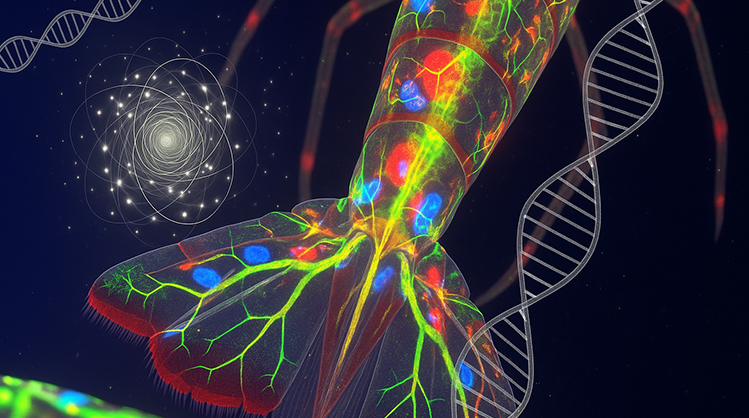
Integrating innovative imaging and genetic tools to deepen our understanding of life's complex forms and their evolution. The image was generated by Google's Gemini.
Keio University researchers have uncovered how shrimp tails transform during molting, using live imaging and genome sequencing to reveal hidden cellular dynamics. Their work shines a spotlight on Neocaridina, a type of freshwater shrimp, as a new useful model for understanding how living organisms build and reshape their bodies. Specifically, the research team, led by Project Assistant Professor Haruhiko Adachi, has revealed how the tail of Neocaridina denticulata undergoes dramatic morphological changes through its first molt. Their findings, published in iScience, demonstrate that two key processes occur after hatching: the branching of uropods and the convergent elongation of the telson.
Using a newly established long-term in vivo live-imaging system with UV-LED resin and fluorescent lectin probes, the team was able to produce images of dynamic tissue and cellular changes before and during molting. This approach captured hemocyte movement, tissue contractions, and anisotropic cuticle furrows that drive structural transformations. The study also produced a draft genome sequence of Neocaridina, laying the foundation for genetic tools such as transgenic fluorescent lines and CRISPR/Cas9 mutagenesis. These advances make Neocaridina a promising organism model for developmental and cytological research.
Why Study Shrimp Tails?
At first glance, the question of how a shrimp tail grows might seem like a narrow topic. Yet biology often reveals its most impactful mechanisms in such seemingly niche setting. By studying shrimp, scientists can reveal general principles that dictate how living organisms build and reshape their bodies. Many animals, including humans, go through dramatic changes as they grow, but crustaceans like shrimp offer something special: they remodel their bodies repeatedly through molting. Each molt gives researchers a fresh opportunity to observe tissues and cells in motion. Because shrimp like Neocaridina are small, transparent, and easy to keep in the lab, they provide a convenient and rare window into processes that are otherwise hidden inside the body.
Shrimp tail studies help answer larger questions:
- How do cells cooperate to make complex shapes?
- What general rules of biology apply across species-from shrimp to insects to humans?
- Can these insights inspire new ideas in medicine, such as tissue repair and regeneration?
By addressing these questions, Adachi's work does more than explain how a tiny shrimp's tail grows-it points toward the universal principles of life's design, reminding us that big discoveries often come from paying closer attention to the small things.
Research Path: Inspiration and Approach
Adachi was motivated to pursue science after observing two landmark studies early in his career:
- A blood-testis barrier study in which his undergraduate mentor, Seiji Takashima, proposed a bold new idea that migrating cells might express claudins to directly traverse tight junctions, challenging conventional thinking.
- A fish pigment patterning study in which his doctoral advisor, Shigeru Kondo, demonstrated that simple interaction rules among pigment cells can generate mathematically describable patterns, revealing what they called the "beautiful principle" underlying complexity.
"This research taught me the value of identifying phenomena that remain fascinating no matter how often one revisits them, and of pursuing their mechanisms until they can be intuitively understood," says Adachi.
Carrying this spirit forward, he developed a live-imaging system for post-embryonic development and now applies it to crustacean morphogenesis. His long-term goal is to uncover fundamental principles of biology that continue to inspire wonder for generations to come.
Looking Ahead
The next steps for Adachi's lab include:
- Genetic fluorescent labelling of specific cell types in Neocaridina
- Molecular dissection of branching and convergent elongation mechanisms
- Comparative studies across crustacean species to identify universal vs. unique developmental processes
By uniting innovative imaging with genetic tools, this research represents a leap toward a deeper understanding of how living systems build complex forms, as well as how these forms evolve.
Published online 5 December 2025
About the researcher
Haruhiko Adachi ― Project Assistant Professor
Graduate School of Media and Governance
Haruhiko Adachi obtained his PhD from Osaka University in 2022 and is
currently a Project Research Associate at the Keio University Institute
for Advanced Biosciences. His research focuses on the cellular and
molecular mechanisms of arthropod development, with particular emphasis
on morphogenesis. His expertise lies in developmental biology and bioimaging.
Kazuharu Arakawa ― Professor
Graduate School of Media and Governance
Kazuharu Arakawa primarily works at the Institute for Advanced Biosciences,
a cutting-edge bioscience research institute established by Keio University
in Tsuruoka City, Yamagata Prefecture. He earned his MA in 2004 and PhD in
2006 in Bioinformatics from Keio University. His research interests range from the extremophile biology of tardigrades through to the biophysics of spider silk.
Links
Reference
- Adachi, H. et al. Post-embryonic tail development through molting of the freshwater shrimp Neocaridina denticulata. iScience. 28, 111885 (2025) | article